
League of Legends isn’t a typical game. If you’re interested in playing, you might start to feel overwhelmed by the ridiculous amount of information you’re suddenly expected to have at your fingertips. Don’t panic.
Follow these guidelines as you begin your long and exciting journey to level 30 (and beyond!) in League of Legends and you’ll be just fine.
Don’t fret about specific characters and positions. At least for the first five levels.
You have to get to level 5 in your League of Legends player profile in order to access the majority of its gameplay options. This includes player-vs.-player games. Everything you do before that point only serves to help you get your feet on the ground, so don’t stress yourself trying to figure out what character, or what position you’re best suited for. The only thing you should focus on is: trying out different characters to see what feels best for you. Do you like melee champions? Or ranged ones? Mages or assassins? These are the sorts questions you should be asking yourself at the very beginning.
Understand the basics of the map and different positions.
In order to talk with your teammates, you need to know what you should actually say. You don’t need to become an expert overnight, but a good place to start learning the core League vocabulary is by familiarizing yourself with the general structure of Summoner’s Rift and the positions one can play on it. Here’s the map:
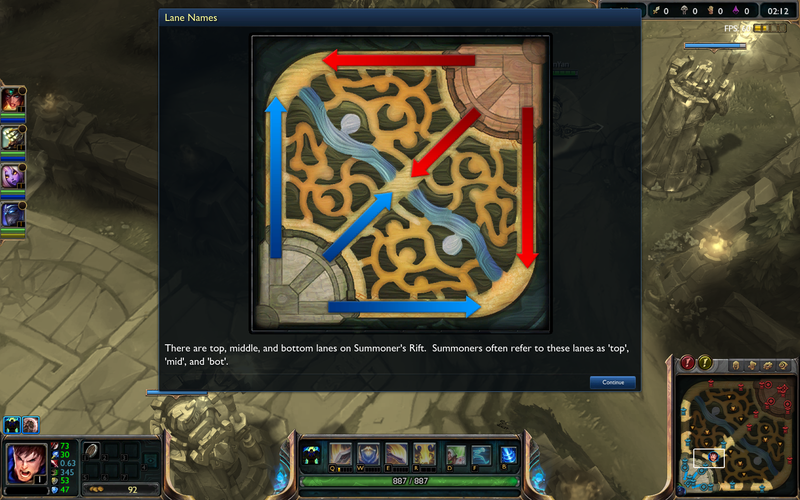
It’s comprised of three lanes—top, middle, and bottom. The area in-between the lanes is the jungle. Team bases are located on the bottom left and top right corners of the map. Your position on the team is determined both by the champion you choose to play as and the specific part of the map you choose to begin the game on. Here are the five main positions that’ll come up in conversation on your way to level 30:
Top: The champion who sticks to the top lane on Summoner’s Rift. Normally played by tanks or bruisers—i.e., melee characters who can either take, or deal, a lot of damage. Or both at the same time!
Mid: Like top, except for the middle lane. Mid-laners are usually champions with solid ability power, or AP for short.
Jungle: The one champion who doesn’t have an assigned lane. Instead, junglers move around the jungle, killing the monsters inside and dropping into any of the three lanes to help their teammates by, say, assassinating an unsuspecting opponent.
ADC: One of two champions assigned to the bottom lane. ADCs are supposed to spend the early part of a game farming minions, leveling up, and buying as much gear as possible to keep increasing their attack damage.
Support: The other champion who plays on the bottom lane. Supports do lots of nice things like: keep ADCs alive, help them land kills, and place wards on the map to increase their team’s visibility.
Look at the mini-map every few seconds.
Map awareness is crucial for pretty much everything in League of Legends. Understanding what is going on in your immediate vicinity is obviously important, but you should keep track of important events that are taking place off-screen as well. If you don’t do this, you can easily be taken by surprise by an enemy you should’ve seen coming. Or miss out on an opportunity to help your team through a difficult fight nearby.
Try all the positions, but focus on one.
You don’t have to head into League with a fully-formed plan of action for how you’re going to spend your first 30 levels. But taking a scattershot approach to your first experiences with the game isn’t a great idea either. Playing a single position over and over again is the best way to learn about its finer details, which helps you improve your abilities in the game and makes it more fun to play.
Don’t get serious about jungling until level 20 (at least).
The one position I wouldn’t recommend starting out with in League is jungling. It’s a more specialized role than the other positions—one that requires specific skills, experience, champions, and in-game items. The first three of those only really come with time. As for the in-game items, you need to be at level 20 to gain access to them.
Find a few favorite champions and play a ton of games with them.

Similar to the team positions, the best way to learn up on a specific champion is to play five, ten, even twenty games with them at a time.
Keep trying new champions, too.
There is so much stuff in League of Legends at this point that you’re not going to be able to experience all of it at once. That doesn’t mean you need to play the game with blinders on, though. At least once or twice a week, you should try out a character you’ve never played as before—say, one that’s on the free champion rotation that week. I’ve found it particularly handy to keep trying out different champions for a single position as they appear on the free rotation.
Try to use champion’s abilities in more than one way.
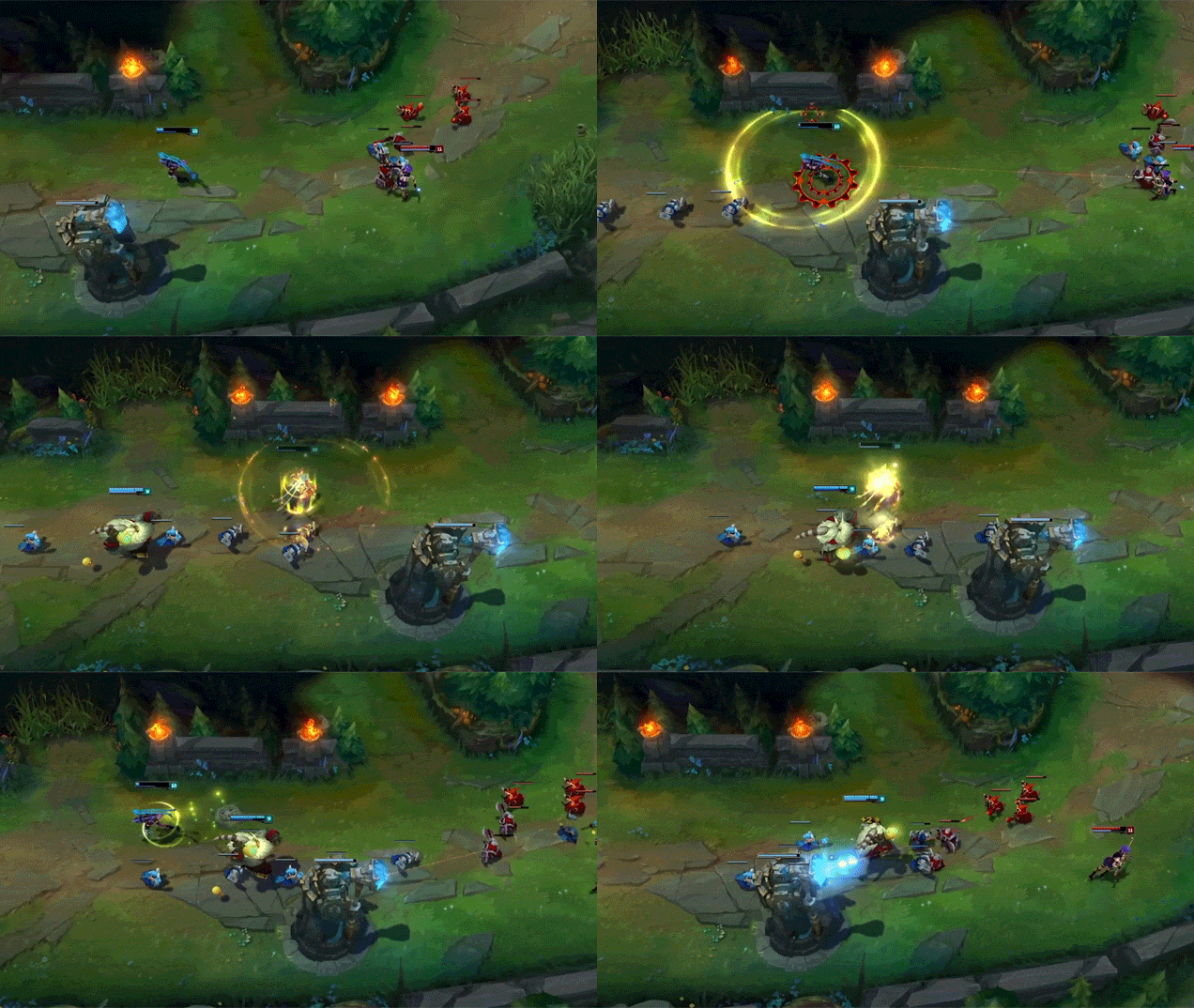
A cool thing you’ll start to discover with enough time and practice is that champion’s abilities are often very useful in totally different ways depending on the situation you’re faced with. Caitlin’s E move, for instance, shoots a net from her rifle that slows down an enemy target. Just as importantly, however, the shot has a powerful kick that knocks Cait backwards. This makes it an incredibly effective tool for making an escape from a tense situation.
As you play with a champion and mess around with their abilities, keep asking yourself if you might be missing something. Does that special attack come with some sort of passive character buff that’s actually more valuable? Is the impact on your champion’s mobility greater than the damage some attack is dealing? What was my opponent doing with this dude in the last game that made him such a pain in the butt?
Memorize these hotkeys.
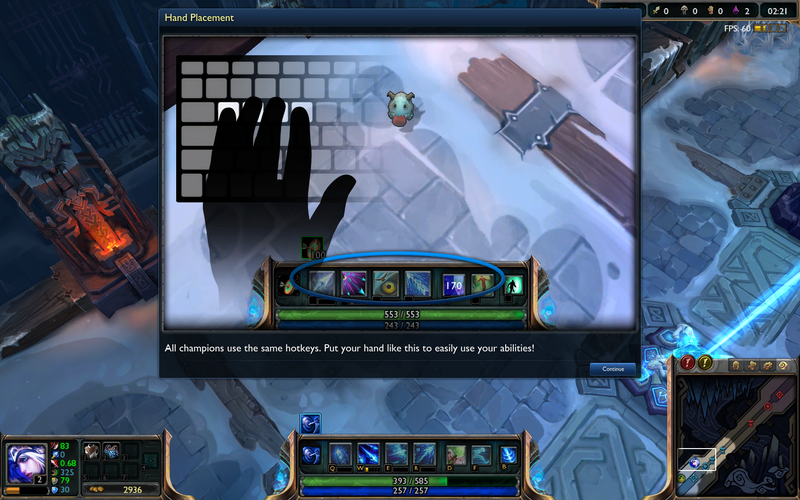
There are a few keystrokes that you should have stored up in your muscle memory by the time you make it to level 30 in League. Here are the main ones:
Q, W, E, R: Your four main abilities.
Ctrl + Q,W,E,R: Level up that ability (without having to click the little plus sign with your cursor)
Alt + Q,W,E,R: Casts spell/ability on yourself (if possible)
Shift + Q,W,E,R: Casts spell/ability at your cursor (if possible)
F, D: Your two Summoner Spells
S: Stop whatever it is you’re doing. Useful to prevent yourself from auto-attacking minions.
1-6: Your items. You only need to press these if a specific item has an active ability.
Spacebar: Centers the camera on your champion. Very useful during team battles when things get super hectic visually.
G: Send pings to your teammates.
Y: Locks/unlocks camera on champion.
B: Recall (teleport back to base)
P: Opens up shop window (use to check prices on items when you’re away from the base)
Tab: Opens up stats page for current game.
Start learning the League language.

Learning to play League of Legends is as much a mechanical process as it is a cultural one. You have to acclimate yourself to the game’s community. One of the main ways you do this is by familiarizing yourself with its unique lexicon. Here are some key terms you’ll see pop up a lot:
CS: “Creep score.” The amount of minions you’ve killed in a game.
CC: Crowd control. Abilities that limit enemy champions’ ability to participate in fights—any move that temporarily stuns, roots, blinds, or disarms a target, for instance.
Drag: Short for dragon, a big scary monster that you often want to kill with the help of your team in order to receive valuable bonuses. If someone types “drag?” they’re usually asking if you can come help them kill the dragon.
Gank: Technically an abbreviation for “gang kill.” Basically, a gank is a surprise attack that makes the ones doing the ganking suddenly outnumber the opponents who are being ganked. Whenever a jungler jumps into a lane to help the teammates there kill their opponents, they’re performing a gank.
Wave clear: A champion’s ability to kill an entire wave of enemy minions in one fell swoop or very quickly.
Bait: Luring an opponent into a trap, usually by tricking them into thinking you’re weak, isolated, or both.
Kiting: Running away from an opponent while simultaneously dealing damage to them.
OOM: “Out of mana.” Often typed as an excuse to prevent some imminent accusation like: “WHY THE FUCK DIDN’T YOU JUST FIRE YOUR ULT?!?!?!”
KS: “Kill-steal,” dealing the killing blow, and thus getting credit for a kill that someone else did all the hard work for.
MR: Magic resist.
Leash: A method used to help junglers by attacking monsters in the jungle to chip away at their health and/or distract them while leaving the final kill for the jungler teammate.
The list goes on and on. The only way to become fluent in League’s language is to keep playing the game and eventually learn to recognize the moments when you encounter something new and unfamiliar. Which leads to my next point…
Don’t be afraid to tell people you’re new.
MOBAs often get a bad rap for being full of jerk players. But a lot of League of Legends players actually enjoy the process of teaching newcomers about the game. Don’t be scared to ask people questions. Informing your team that you’re still in the process of figuring the game out can go a long way.
Communicate with your teammates.
You don’t have to become friends with every person you encounter in League of Legends. You probably won’t, either! But that doesn’t mean you can’t communicate with your teammates effectively. Make sure to always call out your desired position during the pre-game team-building phase. If nobody else is saying anything, strike up a conversation with your allies about how you all want to approach the oncoming game. Some people may be unresponsive and just go about their business. There’s nothing you can really do about that other than to try and lead by example.
Download a few voice-chat programs.
League doesn’t have any built-in voice feature, so you’ll have to look elsewhere for this once you start playing with friends. The usual suspects are: Skype, Curse Voice, Teamspeak, and Mumble.
Use ARAM and co-op to test out new stuff.
League’s “All Random, All Mid” is the closest thing the game
has to a “for fun” mode because a) you’re randomly assigned a champion for each game, b) you can only buy items and potions when you die, and c) it’s played on a one-lane map that sparks non-stop team battles from the very beginning. It also has a magical snowball ability that you’re not allowed to use outside of ARAM. Games against bots, meanwhile, are much easier than player-vs.-player ones; people tend to take things much less seriously in these two game modes. This makes them ideal stomping grounds whenever you want to test out something you’re not quite sure how to use yet.
Look up guides for specific characters.
There are countless walkthroughs and detailed guides for how to “build” individual League characters online. Mobafire, Probuilds, and Lolking are all good places to start poking around for these. The summoner school subredditis also a good resource for beginners. Bear in mind, League guides are not step-by-step instruction manuals. Rather, you should look to them as (somewhat) flexible frameworks for what gear to purchase and what special abilities to level up, specific to your character and position. Playing Morgana as a mid-laner is very different experience than playing her as a support character alongside an ally ADC, so make sure you’re reading the right guide before you start taking its advice.
Triple-check every piece of advice you get.
When you first start playing League of Legends, it’ll feel like you know absolutely nothing and everyone else is an expert at the game. It might be true that you know nothing about League. But I’m going to let you in on an important secret: a lot of people you will come across in League have no idea what they’re talking about. So if someone starts yelling at you to buy thornmail in the middle of a game? Well, you can listen to them in the moment if you feel like it. But once the game is done, make sure to cross-check your teammate’s advice to make sure it actually makes sense.
Comments
Post a Comment